Vyas Gufa
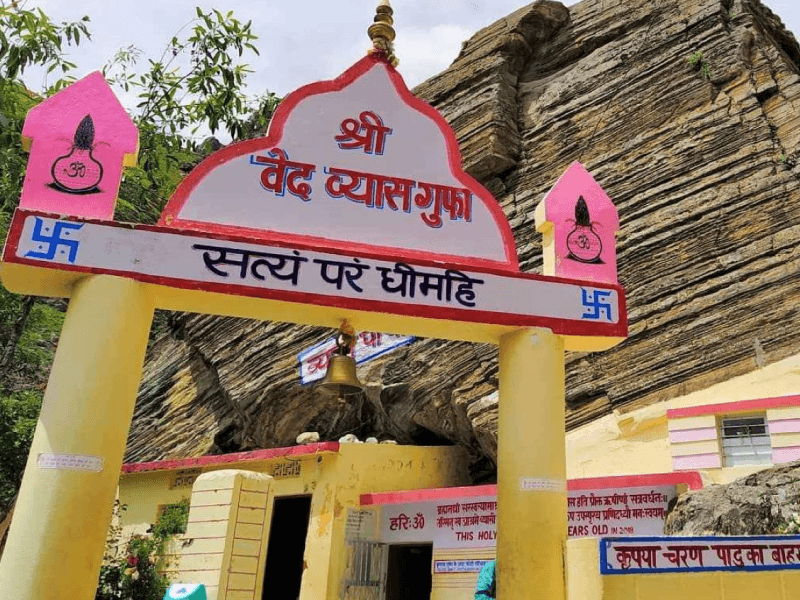
Just before the road gives way entirely and the terrain opens towards the higher reaches of the Himalayas, there is a small cluster of places around Mana that tend to draw attention, some for their views, others for their stories. Among them sits Vyas Gufa, a modest cave that does not immediately stand out unless one is looking for it. It lies close to the edge of the village, slightly elevated, with a stone pathway leading up to it. There are no elaborate markers or large entry gates. A few steps, a gradual incline, and the space reveals itself. For many visitors to Badrinath, this stop comes almost as an extension, something to see on the way, rather than a destination planned in isolation. Yet, once there, the pace shifts. People tend to stay a little longer than expected.
Mana village, often referred to as the last inhabited settlement before the Indo-Tibetan border, is located about 3 kilometres from Badrinath. The road up to Mana is motorable, with shared taxis and local vehicles operating regularly during the open season. Fares usually range between INR 150 and INR 300 per person. From the main parking area in Mana, the walk to the cave is short. It takes roughly 10 to 15 minutes, depending on the pace. The path is stone-paved in parts, with a few uneven sections, but nothing particularly demanding. There is no entry fee to visit Vyas Gufa, though small voluntary donations are often made by visitors at the site.
The cave itself is not large. From the outside, it appears as a natural rock formation, slightly curved, with a constructed entrance that helps maintain its structure. Inside, the space narrows, creating a low, enclosed chamber. There is a sense of quiet here, though not complete silence. Visitors come and go, but conversations are usually subdued.
The space does not encourage noise. Unlike larger temple complexes, there is very little ornamentation. A few idols, a designated area for offerings, and basic lighting enough to see but not overly bright. It is the kind of place where one pauses without quite planning to.
The cave is traditionally associated with Maharishi Ved Vyasa, regarded as the compiler of the Mahabharata. According to local belief, it is here that he dictated the epic, with Lord Ganesha transcribing it nearby. Just a short distance from the cave is another site linked to this narrative, often referred to as Ganesh Gufa. Together, these places form a small but interconnected circuit within Mana. There are no inscriptions or formal displays explaining these associations in detail.
Most of what visitors learn comes through brief conversations with locals or priests present at the site.
For some, this lends a certain authenticity. The stories feel carried forward rather than formally presented.
Arriving at Vyas Gufa does not involve any elaborate process. There are no long queues and no timed entries. Visitors walk in, spend time as they wish, and leave. Some sit quietly inside the cave. Others observe from the outside, taking in the surrounding view of the valley and the distant mountains. The altitude over 3,000 metres adds a certain stillness to the air. The visit itself rarely takes more than 20 to 30 minutes. Yet, it does not feel rushed.
There is a noticeable difference in how people behave here compared to more crowded pilgrimage sites. The pace is slower. Conversations are softer. Even photography tends to be limited.
The region carries associations with the journey of the Pandavas towards heaven. The route beyond the falls is often linked to that final ascent, though it stretches much further into remote terrain. There are no elaborate signboards explaining these stories. They exist mostly in conversation shared by locals, repeated by guides, or picked up along the way. For some, this adds meaning to the walk. For others, it remains just a background detail. Either way, it does not dominate the experience.
The accessible window is relatively short. From May to October, the route remains open and manageable. Early summer sees stronger water flow due to melting snow. By September and October, the skies are clearer, and the surrounding peaks are easier to view. Monsoon months can be unpredictable. Rain makes the trail slippery, and visibility often drops. Winters, on the other hand, close the route almost entirely due to snow. Timing within the day also matters. Starting early around 6:00 or 7:00 AM makes the walk easier. The wind tends to increase later in the day, which can make the return slightly more tiring.
The cave remains accessible during the same months as Badrinath, typically from May to October. During this period, roads are open, and weather conditions are relatively stable. Early mornings and late afternoons are usually quieter. Midday tends to see more visitors, especially during peak pilgrimage season. Monsoon months (July and August) bring occasional rainfall, which can make the stone pathways slightly slippery. Winters close off the region almost entirely due to heavy snowfall.
A visit to the cave does not involve significant expenses, but a few basic costs may be considered:
- Shared taxi (Badrinath to Mana): INR 150-300 per person
- Tea/snacks in Mana: INR 50-200
- Local guide (optional): INR 500-1,000
There are small stalls in Mana selling tea, packaged snacks, and simple meals. Beyond this, facilities are limited. Mobile connectivity is inconsistent, though some networks may work intermittently.
While the walk to the cave is short, the altitude can still be felt, particularly by those arriving directly from lower regions. Mild breathlessness or fatigue is not uncommon. Footwear with a good grip is useful, especially if the pathway is damp. The steps leading up to the cave are manageable, but slightly uneven in places. Visitors are generally expected to maintain decorum inside the cave. Loud conversations and disruptive behaviour are discouraged, though not formally enforced. Carrying large bags is unnecessary for this visit. Most people travel light, given the short duration of the stop.
Mana village has a few other places that visitors often explore alongside the cave:
- Ganesh Gufa-located a short walk away
- Bhim Pul - a natural rock bridge over the Saraswati River
- Saraswati River viewpoint - a brief stop with a strong water current visible
These spots are all within walking distance of each other, making it easy to cover them in a single visit.
There are many caves across the Himalayas, some larger, some more visually striking. This one does not compete on those terms. What sets Vyas Gufa apart is not scale or structure, but its setting and the way it is approached. It sits quietly within an already quiet village, without trying to draw attention. There is no sense of spectacle here. No attempt to impress. And perhaps that is why it leaves a more lasting impression than expected.