Hemkunt Sahib
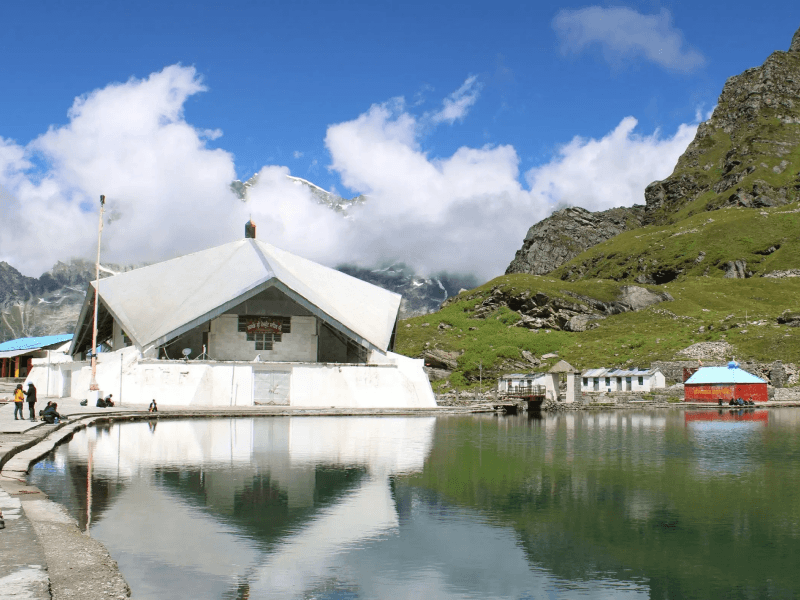
Tucked away behind a fortress of seven shimmering, snow-capped peaks in the Chamoli district lies Hemkund Sahib, a sanctuary where the earth seems to touch the heavens. It is more than just a destination; it is a sacred echo of the Bachitra Natak, marking the very ground where Guru Gobind Singh once sat in deep, ancient meditation. The journey there is a true test of spirit, beginning with a winding trek from Govindghat that sharpens into a gruelling, 1,100-metre vertical climb from Ghangaria. As the air thins and the world falls away, the gruelling ascent transforms into a profound mountain pilgrimage, proving that the most breathtaking views are always reserved for those willing to climb for them.
High in the Garhwal Himalayas sits Hemkunt Sahib, beside a glacial lake that seems almost impossibly still. On clear mornings the water reflects the surrounding peaks so sharply that the mountains appear doubled, rising both above and below the surface.
For a long time, this place remained little more than a quiet mountain basin known mostly to shepherds and wandering sadhus. The terrain was difficult, the weather unpredictable, and there were no marked trails guiding travellers through the slopes.
The turning point came in the early twentieth century when Sikh scholars began searching for a place described in the Bachitra Natak. The text speaks of “Hemkunt Parbat Sapat Sring", a snowy mountain lake surrounded by seven peaks where Guru Gobind Singh is believed to have meditated in a previous life.
After years of exploration, the lake near today's Hemkunt Sahib was identified as the site mentioned in the scripture. The discovery slowly transformed the remote valley into an important Sikh pilgrimage destination.
Yet even today, the place has not lost its quiet character. Reaching it still requires patience, strong legs, and a willingness to walk for hours through steep Himalayan terrain.
And perhaps that effort is part of its meaning.
Several reasons draw travellers toward Hemkunt Sahib, though few people come here casually.
One reason is altitude. At around 4,300 metres above sea level, it is among the highest gurudwaras in the world. The thin air alone changes the pace of everything. Even walking a short distance feels different.
But what people remember most is the journey itself.
The trek begins from Ghangaria, a small settlement surrounded by dense forests and mountain slopes. From there the trail climbs sharply upward. The path twists across the mountainside in long zigzags, sometimes revealing wide views of the valleys below and sometimes disappearing into mist.
Pilgrims move slowly. Some chant quietly. Others focus on steady breathing and careful steps.
By the time travellers reach Hemkunt Sahib, the climb has already become part of the experience. It is difficult to separate the destination from the effort required to reach it.
The icy lake, the gurudwara beside it, and the ring of peaks standing silently around them complete the moment.
The spiritual importance of Hemkunt Sahib comes primarily from Sikh tradition.
In the Bachitra Natak, Guru Gobind Singh writes about meditating in a previous life at a mountain lake surrounded by seven peaks. This description led generations of Sikh devotees to search for the physical location of that sacred site.
When the lake in Uttarakhand was identified as Hemkunt, it became deeply meaningful to Sikh pilgrims. Visiting the site allows them to connect with a moment described in their scripture, one that represents meditation, reflection, and spiritual discipline.
Interestingly, the area also carries significance in Hindu tradition.
A small Lakshman Temple stands near the lake, dedicated to Lakshman from the Ramayana. Local belief suggests that Lakshman meditated here as well after the battle in Lanka.
Seeing the gurudwara and the temple standing in the same valley is something many visitors pause at for a moment. Up here, faith does not seem divided by boundaries. The mountains have a way of making different traditions sit side by side in quiet harmony.
The mountains, after all, belong to everyone who seeks silence within them.
Although the lake itself forms the heart of the pilgrimage, a few nearby places add depth to the journey.
Gurudwara Hemkunt Sahib
The gurudwara sits directly beside the lake. Its design is simple but distinctive, with angular walls built to withstand heavy snowfall during winter months.
Inside, the atmosphere is peaceful. Pilgrims sit quietly while hymns echo softly through the hall. Outside, the wind moves across the lake, carrying the faint sound of prayer.
Hemkunt Lake
The lake itself feels almost unreal at first glance. Its surface often remains completely calm despite the altitude and wind.
Pilgrims traditionally take a brief dip in the icy water before entering the gurudwara. The temperature is shockingly cold, yet people step in with remarkable determination.
Lakshman Temple
A short walk from the gurudwara stands the Lakshman Temple. Though smaller, it carries its own quiet presence
Many travellers visit it before beginning the descent back toward Ghangaria.
Valley of Flowers
During the monsoon season the valley becomes a carpet of colour. Blue poppies, orchids, and dozens of other flowers appear across the slopes, creating one of the most remarkable landscapes in the Himalayas.
Reaching Hemkunt Sahib begins with a journey deep into Uttarakhand's Garhwal region.
Most travellers first reach Govindghat, which lies along the road connecting Rishikesh and Badrinath.
From Govindghat, the trek to Ghangaria covers about 13 kilometres. The path follows the Pushpawati River and gradually climbs through forests and mountain bends. Many pilgrims complete this stretch on foot, though ponies and porters are available.
Ghangaria acts as the base for the final climb.
From here, the trail to Hemkunt Sahib rises steeply for about six kilometres. The climb is demanding, gaining more than 1,000 metres in elevation in a relatively short distance.
Most travellers begin early in the morning and aim to reach the lake before afternoon clouds begin drifting in.
A little preparation makes the journey to Hemkunt Sahib far more comfortable.
First, allow time to acclimatise. Spending a night in Ghangaria before attempting the climb helps the body adjust to the altitude.
Warm clothing is essential. Even in summer, temperatures near the lake can drop quickly once clouds move in.
Carrying enough water and light snacks also helps. The climb can take several hours depending on pace.
Starting early in the morning is often the best decision. The weather tends to be clearer, and the trail is quieter.
Finally, take a moment to simply sit beside the lake before descending.
Many travellers rush down after visiting the Gurudwara. But the stillness of Hemkunt Sahib reveals itself best when you stop moving for a while.
Up there, surrounded by peaks and silence, time seems to loosen its grip.