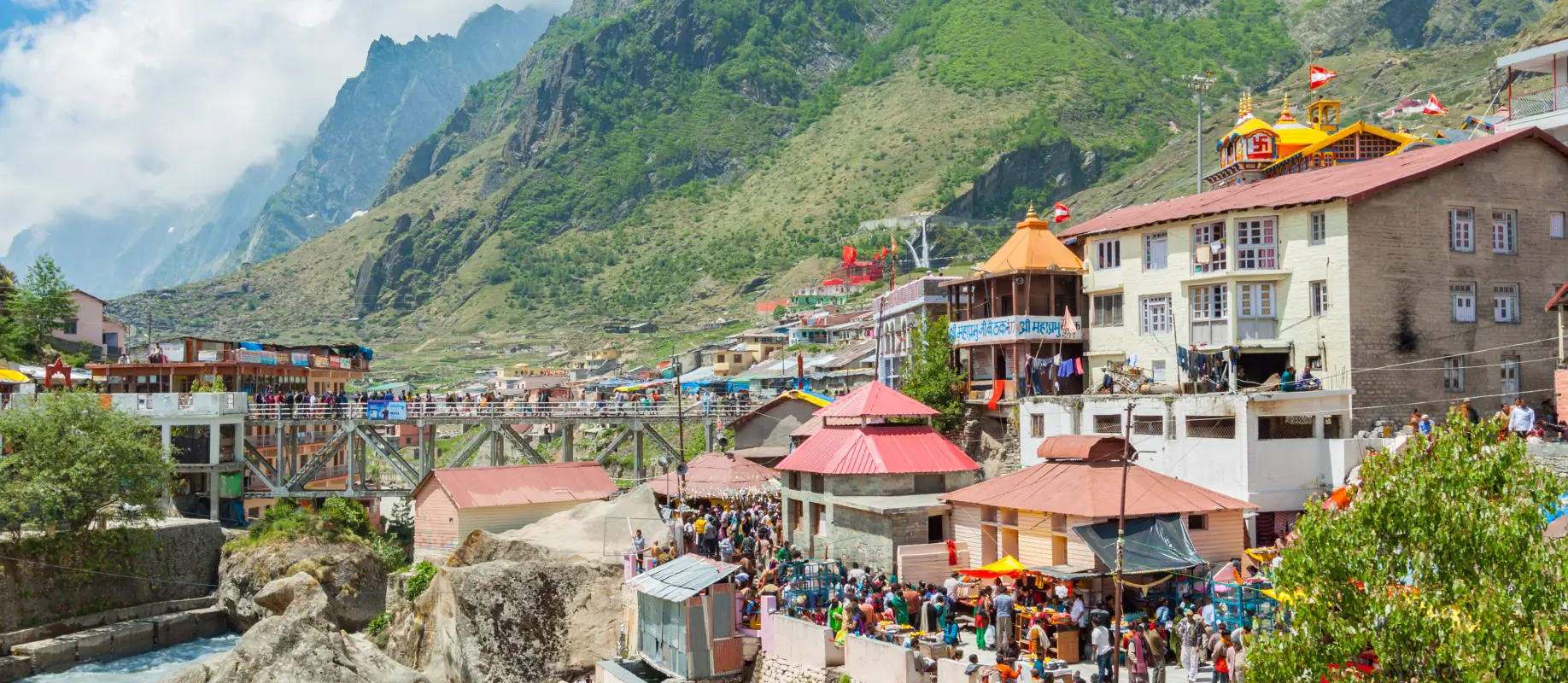
Long before you hear it, you feel something changing. The quiet lanes of Mana Village give way to a deep, continuous roar that seems to echo off the mountains themselves. Then, almost without warning, the river appears – white, restless, impossibly loud. And just as suddenly as it arrives, it vanishes again, swallowed by rock and mist.
Ask anyone standing at the edge what they have just seen, and they will tell you the same thing, in different words: this is the saraswati river badrinath pilgrims have spoken of for centuries. Not a myth exactly. Not quite a fact either. Something in between.
The River That Refuses to Behave Like Other Rivers
Most rivers are patient. They widen, they slow, they let you walk beside them for miles. The Saraswati does none of this.
It surfaces near Mana, thunders past a cluster of boulders and prayer flags, passes beneath a natural stone crossing, and disappears — all within a stretch you could walk in under ten minutes.
Children visiting with their families often ask the obvious question: how can a river simply stop existing? Guides smile at the inquiry. They have heard it a hundred times. "It doesn't stop," one told a group last October, pointing towards the gorge. "It just stops letting you see it."
That single sentence carries the whole mystery of this place.
The Story That Began with the Mahabharata
To understand why the river hides, you have to go back — not decades, but to the age of sages and epics.
According to tradition, it was here, in a cave above Mana, that Sage Ved Vyasa began the enormous task of composing the Mahabharata. The verses came to him faster than any hand could write. He needed a scribe equal to the challenge, and it was Lord Ganesha who agreed to take up the task — on one condition. Vyasa would have to recite without pause, without hesitation, for if his flow broke even once, Ganesha would set down his pen for good.
Vyasa accepted. And so began one of the great feats of concentration in Hindu tradition.
But the Saraswati, flowing just outside the cave, would not stay quiet. Its roar rolled through the rocks, rising and falling, breaking the silence Vyasa needed to hold his thoughts together. Again and again, the sage lost his thread.
Local storytellers differ on what happened next — some say it was Vyasa who cursed the river, others attribute it to Ganesha himself, weary of the interruption. But the outcome, in every version, is the same: the Saraswati was told that from that point on, she would flow largely unseen. Loud, but hidden. Present, but never quite visible.
Whether one hears the tale as literal history or as a story carried down through oral tradition, it is retold at the riverbank almost exactly as it must have been retold a generation ago — a guide gesturing towards the cave, a family pausing mid-conversation to listen, someone glancing instinctively towards the cave mouth as if the sage might still be inside.
Standing Beside the Roaring Saraswati
Nothing prepares you for how loud it is.
Conversation becomes impossible within a few metres of the water. People lean in, shout into each other's ears, then give up and simply point. The spray reaches the nearby rocks in cold, fine bursts, and even in the height of summer, visitors pull their shawls tighter.
The valley here is narrow — barely wide enough for the river to fit through — and that narrowness is exactly what gives the Saraswati its violence. Water that would spread and calm elsewhere is instead forced through a gap, and it comes out white, furious, and glacial.
Prayer flags strung above the gorge snap in the wind. Somewhere below, the water disappears into a fold of rock, and for a moment, before it reappears, there is nothing to see at all. Just sound.
Pilgrims often go quiet here without meaning to. It isn't reverence exactly — or maybe it is. It's difficult to raise your voice, and difficult, standing that close, to think of much else.
Bhim Pul: A Bridge with Its Own Legend
A little further along, a single massive boulder spans the river. This is Bhim Pul, and like most things in Mana, it has a story attached that nobody quite treats as fiction.
The tale goes back to the final journey of the Pandavas, when the five brothers and Draupadi set out on their long walk towards the Himalayas, seeking the path to heaven. They reached this point and found the river impassable — too wild, too wide for Draupadi to cross safely.
It was Bhima, the second of the Pandava brothers and famed for his immense strength, who is said to have lifted a single vast rock and laid it across the water, forming a bridge sturdy enough for his brothers and Draupadi to walk over.
That rock, or one that tradition has come to identify with it, is what pilgrims cross today. The bhim pul saraswati river crossing is barely wide enough for two people to pass comfortably, and yet crowds gather on it anyway — not to rush across, but to stop halfway and look down.
A man in his sixties stood there for a long while on a recent afternoon, saying nothing, simply staring into the churn below. Behind him, a queue formed. Nobody hurried him along.
The Geography Behind the Mystery
Strip away the legend, and a different, equally compelling story emerges — one written not in verse but in ice and rock.
The origin of the Saraswati River lies high above Mana, fed by glacial melt associated with the Satopanth and Bhagirathi Kharak glaciers, the same broad ice fields that also give rise to the Alaknanda. From there, the water descends through steep, narrow terrain before it becomes visible as a defined stream near saraswati river mana village, the only stretch along its entire course where the river can actually be seen by human eyes.
That visible stretch does not last long. Within a short distance, past Bhim Pul, the river merges with the Alaknanda at a confluence known as Keshav Prayag, close to Mana — the last inhabited village on the Indian side of the border with Tibet. From that meeting point onwards, the Saraswati's waters travel on as part of the Alaknanda, eventually reaching Devprayag, where the river becomes the Ganga.
It is a short journey by distance. A handful of kilometres, from glacier to confluence. But few short journeys in India carry this much weight.
Why It Is Called the Hidden Saraswati
Ask a local why the river is sometimes called Gupt Gamini — the one who flows in secret — and they will usually gesture, again, towards the gorge.
For most of its course, the Saraswati is simply not there to see. It runs beneath rock, beneath scree, surfacing only in that brief stretch near Mana before folding itself back under the landscape on its way to Keshav Prayag. Locals describe this as the river choosing invisibility, in keeping with the old curse – present in force but withheld from the eye.
This idea of a hidden Saraswati River is not unique to Uttarakhand. Pilgrims familiar with Prayagraj will recognise the same belief attached to the Saraswati said to join the Ganga and Yamuna at the Sangam there — a river spoken of constantly, yet never actually seen. Two different corners of the country, one shared conviction: that Saraswati exists precisely by not showing herself.
Whether this reflects an underground channel that hydrology has yet to fully map or a river that was always more symbolic than continuous is not a question this article can settle. What can be said is that belief and landscape have, over centuries, folded into each other so completely that it is no longer easy to separate the two — nor, perhaps, is it necessary to.
Why Pilgrims Still Stop Here
Mana is not the destination for most of the people who pass through it. Vasudhara Falls lies further on. Satopanth, sacred and remote, lies further still. And yet almost nobody hurries past the Saraswati.
Devotees fold their hands before the water, murmur something under their breath, and only then continue walking. Some make a point of touching the stone of Bhim Pul on their way across. Others simply sit for a few minutes on the rocks nearby, letting the cold spray settle on their faces, before rejoining the trail.
It is easy to understand why. This is one of the few points on the entire route to Badrinath where mythology and landscape sit this close together – where you can, within the same few minutes, hear a story about sages and curses and watch glacial meltwater do something that genuinely defies easy explanation.
Perhaps that's why people remember the Saraswati less as a river and more as a question. It appears, it roars, it disappears — and somewhere between mythology and mountain geography, it leaves every visitor carrying a story of their own.