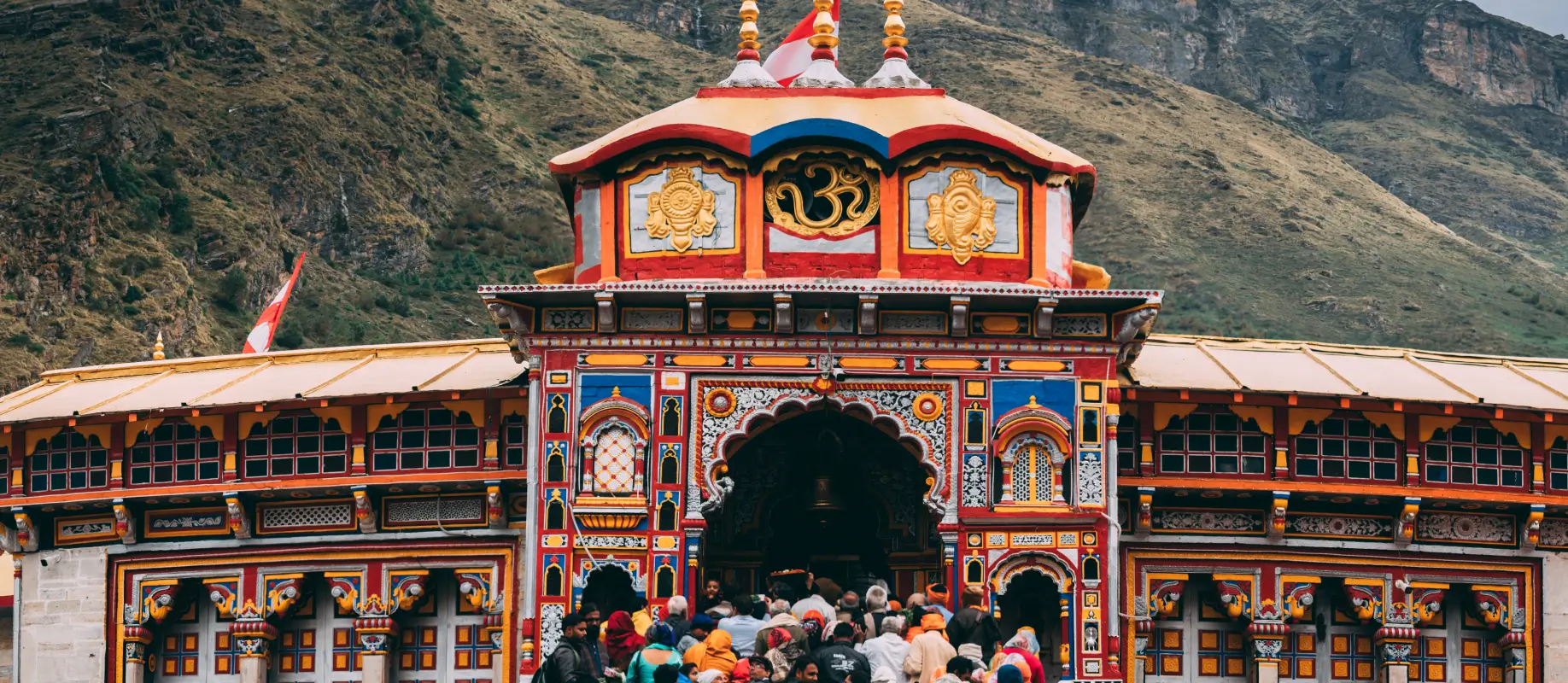
Most pilgrims arrive in Badrinath with one destination firmly in mind. They join the darshan queue, offer their prayers, and prepare for the return journey. Few realise that barely three kilometres away stands a quiet temple that tells the beginning of Badrinath's own story.
That temple is dedicated to Mata Murti, and it rarely makes it onto a pilgrim's list of priorities. Yet without her, the Badrinath most travellers come to see would not exist in the form it does.
The Temple Most Pilgrims Walk Past
There is a particular rhythm to Badrinath. Bells ring in waves, priests call out instructions, and the queue moves in short, shuffling bursts towards the sanctum. It is devotion at full volume.
Walk north along the Alaknanda, though, and that volume fades within minutes. The Mata Murti Temple Badrinath sits on the riverbank in a setting that feels almost deliberately unhurried. Pilgrims slowing their pace after leaving the crowds of Badrinath often say the same thing: they hadn't expected the silence to arrive so quickly.
It is easy to see why the temple gets overlooked. It has no towering shikhara, no long approach road lined with shops. What it has instead is a story most people only half remember.
Who Was Mata Murti?
According to Hindu tradition, Mata Murti was a devoted soul whose penance was so complete that Lord Vishnu himself chose to answer it. She prayed with a single wish: that the divine would take birth through her. Vishnu accepted, appearing in the world as twin sons, Nara and Narayana.
Local belief holds that these were no ordinary children. Nara and Narayana are described in scripture as inseparable sages, born to walk the path of tapasya together. They are said to have travelled from their mother's presence to a stretch of land higher up the valley, a place that would come to be known as Badrikashram, where they undertook their own long penance.
At its centre is something simpler than theology: a mother's longing, granted in a form larger than she could have imagined.
Why Mata Murti Temple Matters in the Story of Badrinath
Ask a priest why pilgrims should stop here, and the answer rarely mentions rituals first. It mentions beginnings. Badrinath, in this telling, is not a standalone shrine but the second half of a story that starts with a mother's prayer.
The mata murti temple history is often summarised in a single line by guidebooks — mother of Nara Narayana, temple near Badrinath — but that compresses something worth more room. Within the wider Char Dham tradition, sites rarely stand alone; each explains the one before or after it. Badrinath's sanctity, in this reading, does not begin with the idol inside the main shrine. It begins with a woman standing on this riverbank, asking for something no one else had thought to ask for.
A local priest narrating the story to curious visitors will often pause here, letting the point settle. Pilgrims who have already completed their Badrinath darshan sometimes go quiet at this stage, as though recalculating what they had just seen.
This is also why many spiritual travellers regard a Badrinath yatra as incomplete without this detour — closer to reading the first chapter of a book after finishing the last.
Devotees believe that prayers offered here carry a distinct character — inner peace, maternal blessings, protection, relief from sorrow, and spiritual strength. These remain beliefs passed down through generations of pilgrims rather than claims of documented history.
A Temple Surrounded by Mountains and Silence
The Alaknanda flows past with a steadiness that has its own kind of voice, loud enough to be a constant companion, never loud enough to interrupt thought. The temple itself is modest, its style owing more to functional hill architecture than to elaborate carving.
What stays with most visitors is the space around it. The surrounding peaks catch the first light of the morning long before the valley floor does, turning briefly gold before settling into grey-brown. Mountain clouds appear and disappear within minutes, drifting across the ridgeline as if testing which shapes suit them best.
Prayer flags flutter softly in the mountain breeze near the temple approach, their colours faded by sun and altitude. The air carries the scent of incense mixed with something colder, something that belongs entirely to the Himalayas. Families sit quietly outside instead of rushing back to their vehicles, an unusual sight along this pilgrimage circuit.
The silence between temple bells here says as much as the bells themselves
Mata Murti Ka Mela
Once a year, this quiet changes character entirely. The mata murti fair, known locally as Mata Murti Ka Mela, transforms the temple grounds into a gathering point for pilgrims and villagers from across the region.
This mata murti festival is observed around Shravan Dwadashi and again during Vaman Dwadashi, dates that shift each year according to the lunar calendar but consistently fall within the monsoon and early autumn months. Local traditions include community singing, ritual offerings, and processions drawing families from Mana village and beyond.
September is widely considered one of the best times to witness this celebration, since the weather has settled after the monsoon and the larger of the two observances tends to fall around then. Pilgrim participation swells noticeably, and the temple, usually so still, takes on a rare, communal energy.
Visiting the Temple
Reaching the temple requires no real planning. It is roughly 3 km from the main Badrinath township, a walk that takes most people between thirty and sixty minutes depending on pace and altitude adjustment. Those who prefer not to walk can find a taxi in around ten minutes, with shared SUVs also running along the same stretch during peak season.
The road runs close to National Highway 58, with the Alaknanda visible for much of the way, and continues towards Mana village, often described as India's last village before the Tibetan border. Many travellers combine the two stops in a single, unhurried outing.
Entry is free, and timings run from 6:00 AM to 12:00 PM and again from 4:00 PM to 9:00 PM. Photography is generally acceptable in the outer courtyard, though visitors are expected to seek permission before photographing the sanctum or fellow devotees at prayer. Modest clothing and a measured tone of voice are appreciated rather than enforced.
Why It Deserves a Place in Every Badrinath Itinerary
Among the various places to visit near Badrinath, this temple occupies an unusual position: not a scenic add-on but a narrative one. Visiting Mana village explains geography. Visiting Mata Murti explains why Badrinath is considered sacred at all.
The mata murti temple distance from the main township is short enough that skipping it has little to do with logistics and everything to do with awareness. Most pilgrims simply don't know the story until after they've already left.
For families on the Char Dham Yatra, mythology enthusiasts tracing Vishnu's incarnations, or culture lovers wanting more than a photograph at the main temple, this detour rewards the slight extra effort with something harder to quantify: context.
The road to Mana feels calmer than expected, and the temple along the way asks for nothing but a pause. Walking those extra three kilometres does not add much distance. It adds an origin story to everything that follows.